
While mouthwash is not an alternative to regular brushing and flossing, it can help keep your teeth and gums clean and healthy. There are several different types of mouthwashes available, and all of them will help do different things for your smile. The most common types of mouthwashes are:
• Fluoride - fluoride is the most used type of mouthwash available, and is used to strengthen the enamel of the teeth while preventing cavities and tooth decay.
• Antiseptic - an antiseptic mouthwash is used to kill bacteria and germs in the mouth. Most commonly used before and after a dental surgery, antiseptic mouthwashes can also help to fight gum disease, and halitosis (chronic bad breath). Antiseptic mouthwashes can affect your sense of taste and may stain the teeth, so it is recommended that you consult your dentist before using this type of mouthwash.
• Combination - a combination mouthwash is designed to help prevent tooth decay, freshen the breath, and maintain the health of your smile.
• Prescription - for patients with gum disease, or any signs of gum disease, you may need a prescription mouthwash. Prescription mouthwashes, like Peridex of PerioGard, are used to treat gingivitis, and other forms of decay.
There are also many different brands of mouthwash. Some common brands include:
• Scope
• Listerine
• Act
• Crest
• Tom’s of Maine (all-natural)
• Plax (anti-plaque rinse)
• Breath Rx
• Orajel
• Targon (special mouthwash made for smokers)
• Rembrandt (whitening mouthwash)
If you are curious about which kind of mouthwash would work best for you, be sure to ask Dr. Weiss at your next appointment. If you have a favorite mouthwash, let us know by posting a comment for others to read!
Friday, August 28, 2009

Thursday, August 20, 2009
Softly Brushing Your Way to Clean Teeth, From Dr. Weiss

Just as there are so many different types of toothbrushes to choose from, each brush also has a different type of bristle! There are generally three different types of bristles; hard, medium, and soft. We always recommend that our patients, especially children and seniors, use a soft bristled toothbrush.
Using a hard and medium bristled brush can actually harm your teeth and gums by stripping the enamel from the teeth and irritating the gums so that they become red and sore, and can even cause gum recession. If you do use a hard or medium bristled brush as a personal preference, we recommend using an electric toothbrush.
Soft bristles are much gentler on your teeth and gums, and while patients of all ages are recommended to use soft bristled brushes, they are particularly great for children, seniors, patients recovering from a dental procedure, and patients wearing braces.
Soft bristles, and even extra-soft bristles are every bit as effective when it comes to cleaning your teeth; in fact, if you currently use a hard or medium bristled brush, try a soft bristled brush next time you buy a toothbrush and we bet you won’t even notice a difference!
--Dr. Danny Weiss
Friday, August 14, 2009
Baby Teeth – and Gums – Need Special Care! From Dr. Weiss

One question we hear all the time is “When should I start brushing my baby’s teeth?”
You should begin regular cleanings even before your baby has teeth. After each breast feeding – or bottle-feeding – use a clean, damp washcloth to gently rub your baby’s gum tissue. You can wrap the material around one finger to make it easier to remove any food bits from your baby’s mouth.
When your baby’s first tooth comes in switch to a baby toothbrush. Look for special baby toothbrushes in your drugstore – they have just a few bristles and are very soft. There are even brushes shaped like finger puppets that fit over the tip of your pointer finger! All you need at this point is water – no toothpaste yet.
After a few more teeth appear, you can start using toothpaste, but you only need a tiny bit, and make sure it doesn’t contain fluoride for the first three years. From the beginning, have your little one practice spitting the toothpaste out after brushing. That way, he or she will already have the good habit of spitting when you switch to fluoride toothpaste, which should never be swallowed.
If you have any questions about caring for your baby’s teeth, please contact Dr. Weiss.
Friday, August 7, 2009
Summer Fun with Dr. Weiss!

Its summer here with Dr. Weiss and team, a season full of vacations, adventures and great memories. Whether you are headed to a barbeque, a camping trip, or just having fun in the sun, we want to hear about it! Leave a comment on our blog and tell us about your summer!
Happy Travels,
-From Dr. Weiss
Friday, July 31, 2009
Brush Your Teeth! From Dr. Weiss
Thursday, July 23, 2009
Braces 101 with Dr. Weiss
Should you need to call Dr. Weiss in case you sustain any damage to your braces, we can help you more effectively if you can tell us exactly which piece is in trouble! Here’s a handy diagram and corresponding list of all the parts that make up your braces.
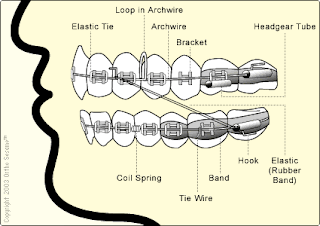
Elastic Tie: Tiny rubber band that fits around the bracket to hold the archwire in place.
Archwire: The main wire that acts as a track to guide the teeth along. It's changed periodically throughout treatment, as teeth move to their new positions.
Loop in Archwire: Frequently used for closing space left by an extraction. Many archwires don't have a loop.
Bracket: Small attachment that holds the archwire in place. Most often, a bracket is cemented directly onto the tooth's surface, eliminating the need for a band.
Headgear Tube: Round, hollow attachment on the back bands. The inner bow of the headgear fits into it.
Coil Spring: Fits between brackets and over archwire to open space between teeth.
Tie Wire: Fine wire that is twisted around the bracket to hold the archwire in place.
Band: A thin ring of metal fitted around a tooth and cemented in place. The band provides a way to attach the brackets to the tooth.
Hook: Welded or removable arm to which elastics (rubber bands) are attached.
Elastic (Rubber Band): Small rubber band that is hooked between different points on the appliance to provide pressure to move the teeth.
-Dr. Weiss
Elastic Tie: Tiny rubber band that fits around the bracket to hold the archwire in place.
Archwire: The main wire that acts as a track to guide the teeth along. It's changed periodically throughout treatment, as teeth move to their new positions.
Loop in Archwire: Frequently used for closing space left by an extraction. Many archwires don't have a loop.
Bracket: Small attachment that holds the archwire in place. Most often, a bracket is cemented directly onto the tooth's surface, eliminating the need for a band.
Headgear Tube: Round, hollow attachment on the back bands. The inner bow of the headgear fits into it.
Coil Spring: Fits between brackets and over archwire to open space between teeth.
Tie Wire: Fine wire that is twisted around the bracket to hold the archwire in place.
Band: A thin ring of metal fitted around a tooth and cemented in place. The band provides a way to attach the brackets to the tooth.
Hook: Welded or removable arm to which elastics (rubber bands) are attached.
Elastic (Rubber Band): Small rubber band that is hooked between different points on the appliance to provide pressure to move the teeth.
-Dr. Weiss
Friday, July 17, 2009
Age 7 is the Magic Number For An Orthodontic Assessment

Many parents assume they must wait until a child has all of his or her permanent teeth, only to find that treatment would have been much easier if started earlier. Some orthodontic problems are easier to correct while the jaw is still growing. Consequently, the American Association of Orthodontists and Dr. Weiss recommend that every child have an orthodontic check-up no later than age seven.
What’s so great about age seven? Enough permanent teeth have arrived for an orthodontist to make a determination about whether any problems are present. The first molars have come in, providing an opportunity to check for malocclusion, or “bad bite.” Also, the incisors have begun to come in, and problems such as crowding, deep bites, and open bites can be detected.
Orthodontic evaluation at an early age provides one of two positive outcomes: For some, early identification or problems will lead to easier or shorter orthodontic treatment in the future. For others, a healthy prognosis will provide immediate peace of mind.
Early evaluation, of course, may signal a need for early treatment. For some children, early treatment can prevent physical and emotional trauma. Aside from spurring on years of harmful teasing, misaligned teeth are also prone to injury and detrimental to good oral hygiene.
If you have any further questions or would like to bring your child in for a consultation, give Dr. Weiss a call at 901-767-7370.
Subscribe to:
Posts (Atom)


 Posts
Posts


